Welcome to sarah's Little Hearts

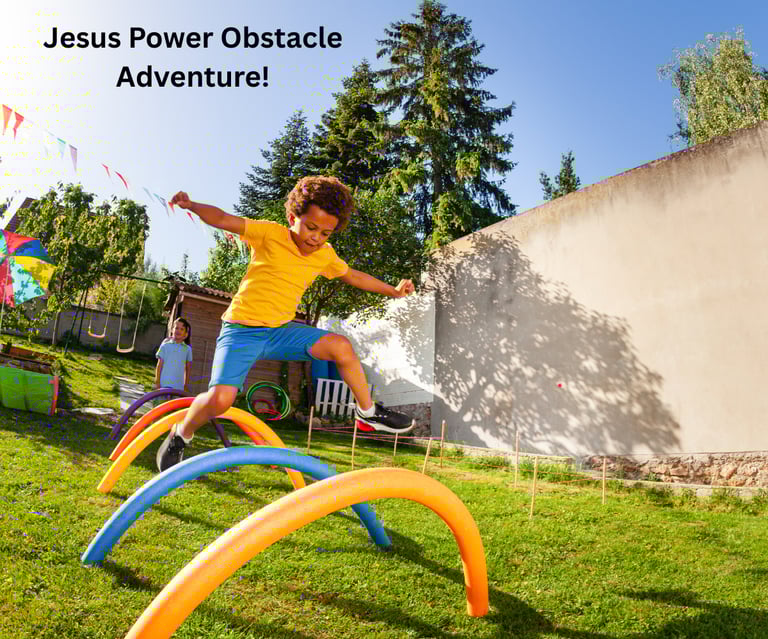
Activity 1: “Jesus Power Obstacle Adventure!”
Theme: Jesus gives us strength and energy to do what needs to be done, and He delights in our joy! Ages:3-5
Set-up: Create a simple obstacle course in a grassy area or playground. Include stations like:
Jumping over “joy puddles” (hula hoops or chalk circles)
Crawling through the “Tunnel of Trust” (cardboard boxes or play tunnels)
Balancing on the “Bridge of Bravery” (a low beam or line of tape)
Running to the “Finish of Faith” (a flag or cross marker)
You can decorate each station with cheerful signs and symbols, smiley faces, hearts, suns, or scripture snippets like “Jesus gives me strength!” (Philippians 4:13).
Faith Connection:
Before starting, gather the children and say:
“Today we’re going to use our strong bodies to move and play! Did you know Jesus loves when we are having fun? He gives us energy to do hard things and helps us when we feel tired or unsure. Let’s thank Him for our bodies and the fun we get to have!”
After the course, sit together and reflect:
“Which part was the hardest?”
“Did you feel strong?”
“Who helps us when things feel tricky?”
“How do you think Jesus feels when we laugh and play?”
Optional:
Play a joyful worship song like “My God is So Big” or “Jesus Loves Me” while they run the course. You could even do a second round where they shout “Jesus gives me strength!” at each station.



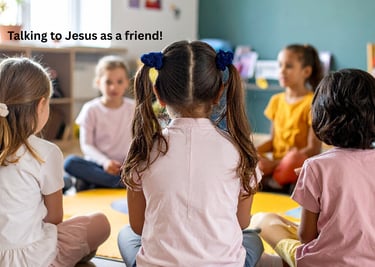
Friendship Role-Play Activity 2: Talking to God Like a Friend
Purpose: To help children understand that God is always near and loves to hear from them, just like a best friend or a loving parent.
Set up: Gather the children in a circle or have them sit comfortably. Explain that they’re going to pretend to talk to a friend, and then learn how they can speak to God in the same way.
Step-by-Step Guide:
1. Warm-Up Question: “What do you talk about with your best friend?”
Let children share things like toys, feelings, fun plans, or worries.
2. Role-Play Partnering: Pair children up or have them talk with you. One child plays “the friend,” and the other shares something simple:
• “I had fun at recess today.”
• “I felt sad when my toy broke.”
• “I hope we have pancakes tomorrow!”
3. Switch to Prayer Mode:
Now say: “Let’s pretend we’re talking to God instead. He’s our friend too!”
Invite them to say the same thing, but as a prayer:
• “God, thank You for recess today.”
• “God, I felt sad when my toy broke. Please help me feel better.”
• “God, I hope we have pancakes tomorrow!”
4. Encourage Expression: Let them know they can whisper, speak out loud, or even draw their prayer if they prefer.
5. Wrap-Up Thought: Say, “God loves hearing from you. You can talk to Him anytime, when you’re happy, when you’re sad, or just when you want to share something."
A "Body Map" of Feelings Activity 3:
Helping children build an "emotional vocabulary" is like giving them a flashlight to navigate their internal world. When they can name a feeling, it becomes less overwhelming and more manageable. Use this activity to help children connect their physical self with their emotional self and feelings.
How to do it: Trace the child's outline on a large piece of butcher paper. Ask them, "Where do you feel 'nervous' in your body?"
The Goal: They might color their tummy red for butterflies, or their hands might be shaky, or their head might hurt.
Why the outline works: it reinforces the idea that emotions are physical experiences, helping them recognize the "early warning signs" of a big feeling before it leads to a meltdown. Having a physical chart helps a child transition from the "emotional" brain to the "logical" brain by giving them a concrete task to focus on.
Expanding the "Body Map" Activity
To make this truly effective, you want to help the child become an "Emotion Detective." Color-Coding Sensations: Use different colors to represent different physical sensations. Red for "Heat" (hot ears, sweaty palms, red cheeks).
Blue for "Heavy" (shoulders dropping, legs feeling slow).
Yellow for "Tight/Buzzy" (clenched fists, butterflies in the stomach).
The "Internal Weather" Scan:
Throughout the day (not just during stress), ask: "If you were a scientist scanning your body right now, what would you find? Any buzzy spots? Any quiet spots?
"The 'Early Warning System' to Avoid Meltdowns
The key to avoiding a meltdown is catching the "rumble stage" before the "erupt stage." Once a child is in a full meltdown, their "upstairs brain" (logic) has essentially disconnected from their "downstairs brain" (survival).
To help them stay regulated, try the "Red Light, Green Light" Body Check:
Identify the "Rumble" Signs: Work with the child to figure out what their body does just before they get really upset. Does their voice get louder? Do they start tapping their foot? Do they go silent?
Create a "Cool-Down Menu": Once you identify a rumble sign, offer a pre-planned sensory "reset."
The "Wall Push": If they feel "buzzy" or aggressive, have them push against a wall as hard as they can for 10 seconds. This provides proprioceptive input, which is naturally grounding for the nervous system.
The "Drain": Have them tighten every muscle in their body (hands, shoulders, face) like a frozen statue, then "open the drain" and let all the tension leak out of their fingertips until they are floppy like a noodle.
Five-Finger Breathing: Have them trace their hand with a finger from the other hand. Inhale as they go up a finger, exhale as they go down. This forces the brain to coordinate touch, sight, and breath simultaneously.
Why This Works: By focusing on the body, you avoid the need for complex language. During high stress, the language centers of the brain often shut down. Physical movements, like pushing a wall or deep breathing, communicate directly with the nervous system to say, "You are safe. You can calm down now."
The "Cool-Down Menu.
"Having a physical chart helps a child transition from the "emotional" brain to the "logical" brain because it gives them a concrete task to focus on.
You can hang this at eye-level in a quiet corner (often called a "Quiet Corner" or "Calm-Down Space"). When you notice those "rumble" signs, like clenched fists or a louder voice, you can calmly point to the menu and ask, "Your body looks a little 'buzzy.' Which one should we try?" Working together with the child like this can be a helpful way to help them identify their emotions and share their feelings with you.